Are these accurate? How should I know? What do I look like, some kind of Proto-Indo-European guy? But it's still fascinating, just to imagine these long-dead tongues brought back to life.
Showing posts with label Russian. Show all posts
Showing posts with label Russian. Show all posts
Wednesday, October 7, 2015
Listen to Ancient Languages
Have you ever (I mean "always") wanted to know what ancient languages actually sounded like? Here's your chance:
Are these accurate? How should I know? What do I look like, some kind of Proto-Indo-European guy? But it's still fascinating, just to imagine these long-dead tongues brought back to life.
Are these accurate? How should I know? What do I look like, some kind of Proto-Indo-European guy? But it's still fascinating, just to imagine these long-dead tongues brought back to life.

Friday, April 10, 2015
Roll on, Bureaucracy

So who are these labels for? And who decided they needed to be there?
I don't think it's a simple, economical way to help government workers identify foreign languages. Or... maybe it is. Maybe if all of the languages are labeled in English then people who speak only English know how to find the right forms for a given situation? But usually when I see this phenomenon—as on this page of a form I received in the mail today, with Korean, Laotian, and Russian instructions—there's a whole bunch of languages listed, and not just one.
Here's a slight variation I spotted while researching health insurance plans:

In this version, at least the names of the languages appear in those languages, albeit after the superfluous English names.
I'm going to file this one under Mystery: unsolved.
Addendum: After writing this post, more of these things have surfaced. Now I see them everywhere. In figure 3, the name of the language appears—bolded and in English—after the text. Which seems pretty unreasonable to me. And in figure 4, well... Just look.
 |
| Fig. 4 |
 |
| Fig. 3 |
Now comes figure 5, from a beach in Bellingham, Washington. The breadth of Asian languages represented is impressive. But... why English labels, again?
 |
| Fig. 5 |
And here's one I saw on an online survey. This one fails in a number of ways.
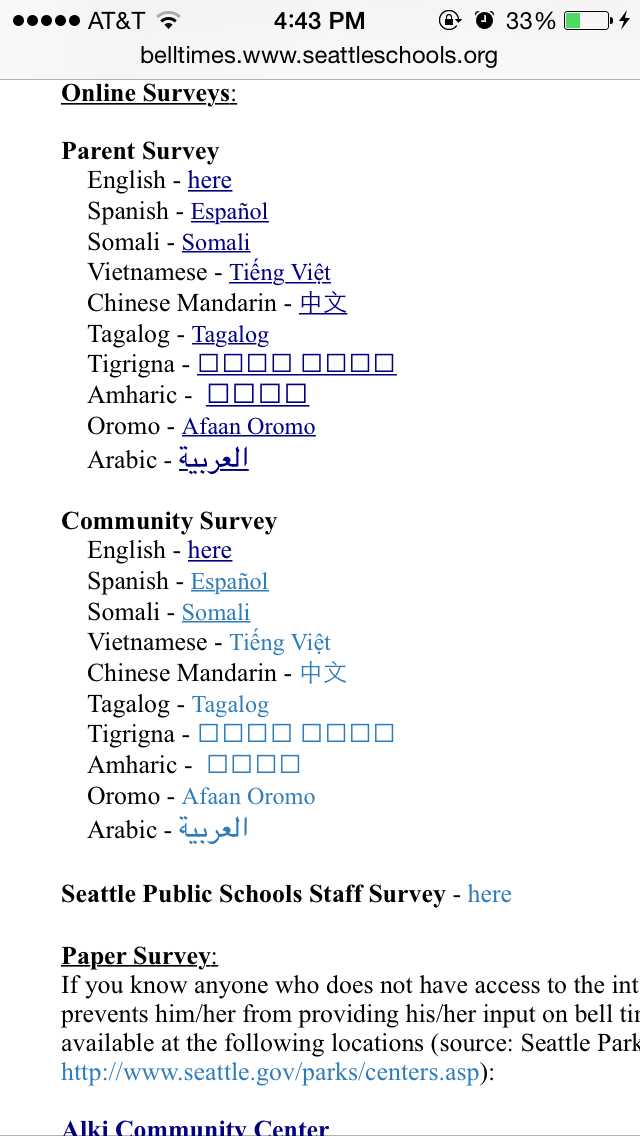 |
| Fig. 6 |
Subscribe to:
Posts (Atom)